
Key Differences and Implications
In the world of cryptocurrencies, the terms “coin” and “token” are often used interchangeably, but they have distinct differences. A coin is a digital asset that operates on its own blockchain—a decentralized, distributed ledger. Examples include Bitcoin, Ethereum, and Litecoin. Coins have their own unique code and function independently of other cryptocurrencies.
A token, on the other hand, is a digital asset built on top of an existing blockchain, such as Ethereum. Tokens are often created to represent a specific asset, like a share in a company or a unit of a commodity. They can also provide access to a service or product, or enable certain functionalities within a blockchain network.
While both coins and tokens serve as digital assets, their underlying technologies and purposes are different.
Understanding Cryptocurrency Coins
As a medium of exchange, they offer a fast, secure, and decentralized alternative to traditional payment methods like bank transfers and credit cards. Cryptocurrencies can be used to purchase goods and services both online and offline, and some businesses even accept them directly as payment.
As a store of value, cryptocurrencies are less affected by the inflationary pressures that impact fiat currencies, and their value can potentially appreciate over time.
Finally, cryptocurrencies are often used as a speculative investment, with traders buying and selling coins to profit from price fluctuations. However, due to their high volatility and associated risks, it is crucial to conduct thorough research and fully understand the market before investing.
Differences Between Coins and Tokens
A cryptocurrency token is a unit of value created and managed on an existing blockchain, such as Ethereum. Unlike coins, tokens do not have their own blockchain but are built on top of an existing blockchain infrastructure. Tokens are often issued through an Initial Coin Offering (ICO) or Initial Token Offering (ITO) to raise funds for a new project or startup.
Purposes Of Cryptocurrency Tokens
Tokens are often created through Initial Coin Offerings (ICOs), where developers raise funds for their projects by selling tokens to investors. These tokens can represent a wide range of assets, including real estate, art, or intellectual property rights, and their value can fluctuate based on market demand.
Tokens can also be programmed with smart contracts—self-executing contracts where the terms of the agreement between buyer and seller are directly written into code. This enables the automation of complex agreements, eliminates the need for intermediaries, reduces costs, and increases efficiency.
Overall, the versatility and programmability of tokens make them a powerful tool for blockchain-based applications and the development of decentralized ecosystems.
In Summary
While both coins and tokens function as units of value in the cryptocurrency ecosystem, they have key differences. Coins typically operate on their own blockchain and are used primarily as a general form of currency. Tokens, on the other hand, are built on top of an existing blockchain and are often designed to serve a specific purpose or function within a broader ecosystem.
USDT on Different Blockchain Networks
USDT (Tether) is a widely used cryptocurrency pegged to the US dollar, valued for its stability and liquidity by traders and investors worldwide. However, it’s important to note that USDT exists on multiple blockchain networks, each of which can have different features and characteristics.
USDT: Blockchain Options and Differences
One of the main differences between USDT on various blockchain networks is the underlying blockchain technology. USDT is available on multiple networks, including Ethereum, Tron, Binance Smart Chain, and others. Each network has its own unique features, such as transaction speed, security measures, and token standards.
USDT Availability Varies Across Blockchains
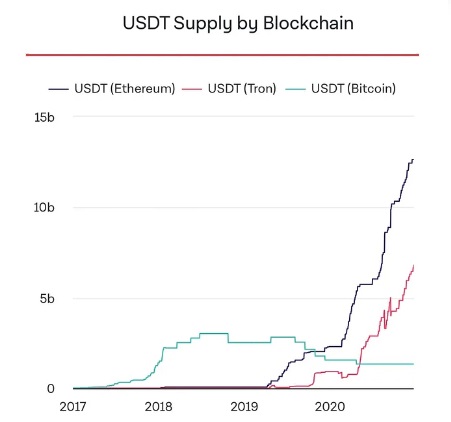
Another key difference is the availability of USDT across different blockchain networks. Although USDT exists on multiple blockchains, the supply on each network can vary. For instance, the amount of USDT on the Ethereum network is significantly larger than the supply on the Tron network.
Blockchain Speed and Fees Comparison
Transaction fees and network speeds can also vary between blockchain networks. For example, the Ethereum network is known for its high transaction fees, often caused by network congestion due to high demand. This has prompted many developers and users to seek alternative networks with faster speeds and lower fees. One such network that has gained popularity is the Binance Smart Chain, which provides quicker transaction processing and lower fees compared to Ethereum.
USDT Incompatibility Across Blockchains
It’s also important to note that USDT on different blockchain networks may not be compatible with one another. For example, USDT on the Ethereum network cannot be used on the Tron network, and vice versa. Traders and investors must ensure they are using the correct USDT token for the specific blockchain network they are transacting on.
In Conclusion
While USDT exists on multiple blockchain networks, it’s important to understand that each network can have distinct characteristics. Traders and investors should conduct due diligence and familiarize themselves with the differences between USDT on various blockchains before trading or investing. This ensures they make informed decisions and use the correct USDT token for their specific needs.
